




Her Campus Media (HCM), the 17-year-old online magazine and media ecosystem for female college students, primarily in the US but increasingly also in Canada and the UK, is acquiring Rebel Girls, the 10-year-old publisher of children’s books.
HCM’s seventh acquisition is its biggest by far, the first since the company became majority-owned by Soros Fund Management – and just two months since co-founder and former sales chief Windsor Western became CEO. The 2024 change of control had seemed to indicate a strategy of larger-scale acquisitions and, although no price is disclosed for the Rebel Girls deal, it seems likely to be at least the $21mn fund-raised from investors, including Penguin Random House which will be responsible for publishing the Rebel Girls books.
For the three HCM founders – who remain “significant” shareholders in the company – this week’s deal might reflect the Soros delight with its investment. HCM is estimated to have increased revenue 10x since 2020 – and by more than 70% in the two years. The company, which had been bootstrapped, was trading at breakeven in 2020 (on revenue of just $8mn), although its six small acquisitions had been self-funded.
For 2026, revenue is expected to be a stunning 40% increase on 2025, with EBITDA of $27mn (2025: $17mn) and an estimated profit margin of 35%.
| SnapShot Her Campus Media LLC | ||||
| $mn | 2026 | 2025 | 2024 | 2023 |
| Revenue | 78 | 56 | 45 | 30 |
| EBITDA | 27 | 17 | 15 | 8 |
| Margin | 35% | 30% | 30% | 25% |
The seven-year revenue performance, under now CEO Western, was largely generated by branded content and events which, during relatively unpromising times, underline the distinctive leadership position established by HCM and its 135,000 “influencers” at 2,300 colleges and universities across the US, UK, Canada, Japan, Australia, India, South Africa, Ireland, Brazil, Singapore, and Nigeria. Its ‘by students for students’ business model has been propelled by thousands of passionate volunteers.
Western says the Rebel Girls deal is just the start of an acceleration in the company’s plan to build a major media platform for “all” young women and girls.
It’s a real breakout strategy.
She told Flashes & Flames: “We’ve focused on the college age demographic for our first 17 years and have expanded upwards a little bit into Gen Z solutions for those first few years post-college graduation, so essentially we’ve spoken to women aged 18-24. We have recently been thinking about the next chapter of the company and where the gaps are. We’ve all seen how social media is not safe for children, about it being built to be addictive. As the mother of daughters aged 9 and 11, I make sure they’re not allowed anywhere near social media. But where are the media companies creating content that’s safe for children, that’s empowering them and helping them to see positive role models that will open their eyes to the possibilities?”
The partial answer to the question is Rebel Girls which had started with the hugely successful “Good Night Stories for Rebel Girls”. It kickstarted the company targeting 7-12 year-old girls (and their parents) – and remains a bestseller. The distinctive publishing imprint claims to have inspired over 50mn girls across 115 countries, with its book series having sold over 11mn copies translated into 62 languages. Its audio series claims more than 30mn downloads, and its girl-first video series more than 80mn views. Despite the international book sales and brand growth, it is believed that Rebel Girls has under-performed financially and may have been loss-making in recent years.
But it’s a big brand.
The HCM CEO says: “Rebel Girls set the standard for introducing young minds to inspiring role models and sparking their confidence. By joining forces, we are bridging the gap between early inspiration and young adult achievement to support our community through every milestone.”
There’s also a huge opportunity for women’s sport: “Rebel Girl Sport is one of the main platforms within Rebel Girls. We’re going to be formalizing some sponsorships and partnerships with the women’s sports leagues. Some 94% of women C-suite executives played sports growing up and 80% of all girls say sports make them feel more confident. It’s a great opportunity for us and them.”
Her Campus also operates college-athlete programmes and both share Nike sponsorships. At a time of growing sports sponsorship and of women’s sports, this seems the area most likely to yield major synergies and early success.
Outgoing Rebel Girls CEO Jes Wolfe (ex management consultant and banker) says: “We believe that confident girls will radically transform the world. Together with thousands of women and girls who shared their stories, dreams, and actions with us, we built a platform for a plurality of voices. I’m excited to see this work continue, with the Her Campus Media creator network, which will give new meaning to ‘built by girls, for girls.’ “
The Rebel Girls’ mission to address what it had told would-be investors in 2023 was “a gender confidence gap” that grows among 6-12-year-old girls, chimes with HCM, as does the emphasis on sports and an “omni-channel universe” across books, digital, entertainment and experiential.
However, the two markets are scarcely adjacent and the contrast between the lean marketing services of HCM and Rebel Girls, as a publishing, licensing and rights business, seemingly could not be greater. But the CEO is excited, to say the least, by the prospect of selling advertisers a combined “girlhood-to-career” female audience story unmatched by competitors.
And the ambitions are greater still.
Windsor Western says “I want to build a young women’s version of, say, Conde Nast. There’s an enormous opportunity with the decline of Cosmopolitan and do you remember how Teen Vogue was targeting 25-year-olds and became totally inappropriate for teenagers? And Cosmo Girl’s gone and 17 isn’t doing print anymore.” Her passionate memories of the magic of teen girls’ magazines is striking and, presumably, significant.
With Rebel Girls giving HCM coverage now of 7-12-year old girls, in addition to its own leadership of 18+ college women, Western is preparing to close the gap for teenage girls with digital content, long-form video – and print. The company seems almost certain to create a magazine to help capture audiences long since abandoned by the major publishers. Maybe early in 2027.
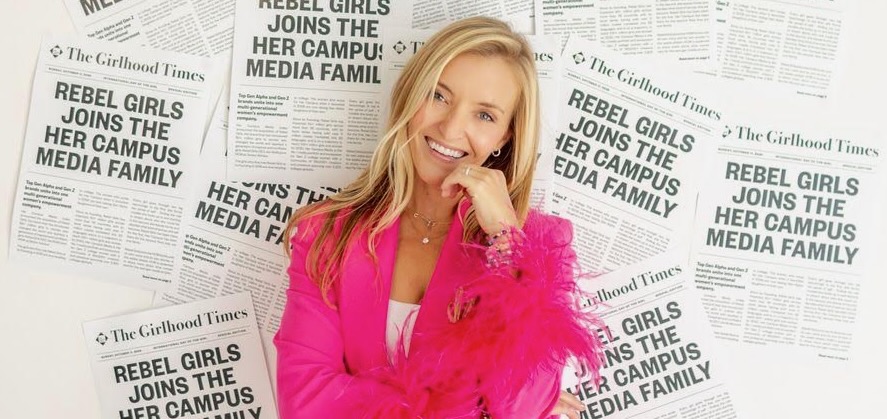
Western’s strategic enthusiasm makes the 2009 launch of HCM a distant memory. when she and fellow Harvard University students Stephanie Kaplan Lewis and Annie Wang hatched the idea of an online magazine targeting college women like themselves. They had been working together on Freeze, a college lifestyle magazine, and changed it to digital with fresh daily content, primarily for women. It also attracted readers from other US campuses.
Former CEO Kaplan Lewis said: “We realized there wasn’t really an online media outlet targeting the college market with relevant content. And who better to provide that content than us, the students who related to it most? None of us had a business background. It was really created by our desire to serve our audience, which was us at the time.”
Even before graduating, they had created their own online service to give US college women practical advice and inspiration on style, health, love, college living, and careers. It also contained micro-sites for localised content provided by students themselves.
Lewis, Western and Wang won a startup competition in Boston which gave them $50k and a free office for a year. That – and $500 borrowed from a founder’s father (and repaid two weeks later) – was the only funding, and they’ve been profitable more or less ever since. By the time they graduated in May 2010, Her Campus was pumping content to and from 30 colleges round the US.
It was an instant hit.
Their objective was to create a place for college women interested in journalism, marketing and media, giving them what was described as “a taste for working in media at a fun, Cosmo-esque publication”. As Lewis said, Her Campus let young women get published on a reputable site, helping them to get other journalistic opportunities: “When employers see Her Campus on a girl’s resume, they know that she’s a quality candidate with experience.”
The Soros deal in 2024, at an estimated enterprise value of $150-200mn, was the first time HCM had an outside investor. It has proved to be a game changer, even though Kaplan Lewis who this year stepped back as CEO, to be succeeded by Western, had said: “They really love what we do and aren’t looking to change it.” Western now says Soros has “unlocked a new universe of scale and possibility”.
Suddenly, there’s a lot more ambition.
In Western’s words, HCM’s acquisition of Rebel Girls will help to build “a multigenerational storytelling platform that supports audiences across key life stages. The girls who first discovered Rebel Girls at its founding in 2016 are now heading to college, while many of the women who wrote for Her Campus when we launched in 2009 are now professionals raising daughters of their own”.
Stand by for more M&A, not least bolt-on deals to help transform HCM into a comprehensive platform for girls and young women with, perhaps, a formal membership network for post-graduate women. But its priority seems to be to re-create the heyday of the legendary Cosmopolitan magazine, which once generated almost 100% of Hearst’s total profit. Along the way, HCM’s core college womens’ business might just become a lot more international, especially in the UK. The agenda is filling up for a brilliant company that’s graduating to the big time.
Exciting times. Keep watching.
