




Adam White is founder and CEO of the 12-year-old Front Office Sports (FOS), self-described as “the leading media news organization covering the business of sports.” It claims a monthly cross-platform reach of 2mn+ (some 75% in North America) through newsletters, social media and now also broadcast TV. It tells advertisers: “Sports prosumers are well-educated, influential, early adopters. They define success by being multi-hyphenate leaders at work, at home and in life. They’re fans who crave more than just the score – they want richer storytelling that helps them upgrade their sports consumption”.
White has long aimed to make it the Politico of sports, appealing equally to upscale consumers and the sports industry audience. He told Flashes & Flames earlier this year: “Our audience is made up of prosumers. They’re professional consumers who work in white-collar industries like tech, finance, media, real estate, and marketing. And that’s our whole thesis: all these athletes want to be business people and all these business people were athletes or are connected to sport in some way – or are very interested in it. And people now really, really care about what happens off-the-field because owners have become larger-than-life personalities. Athletes are now billionaires.”
FOS will this year make its first full-year profit, on the back of $20mn revenue which has more than trebled in three years. Up to one-third of the revenue is believed to be generated by portfolio of 10-12 events. The transformation is seen largely to have been the result of a deliberate ‘prosumer’ push after starting out essentially as a B2B brand. That’s the parallel with Politico and, perhaps, other media brands in upscale activities like food & wine, boating and travel.
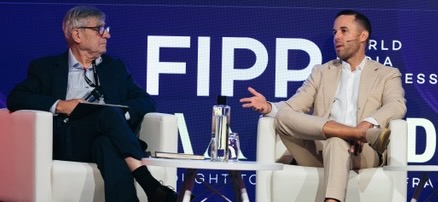
I interviewed White at this week’s FIPP World Media Congress, in Madrid. Here’s our conversation.
How do you describe Front Office Sports?
We’re a media news organization covering the business of sports, currently in North America. The business of sports is really everything that’s happening off the field of play when it comes to the sporting landscape. That can be everything from team sales to media rights deals, to what’s happening with Taylor and Travis from a celebrity standpoint. And it’s been great. I mean, I started it in college 12 years ago.
It was just me doing informational interviews with people who worked in sports. I’d call ’em up and I said, Hey, let me tell your story’. And so I did that and did 110 informational interviews.
During those interviews, I asked people what else they wanted to see in this ecosystem. And, at the time, there was really only one business focused publisher in sports. There’s a couple more entrants in the market now and, domestically in the US, some of the bigger publishers like Bloomberg and Wall Street Journal are also trying to do things. I had randomly met our first investor on Twitter, of all places, and we started chatting. He had just sold his company and said we should figure out a way to do something. It took us a couple months and then, at the end of 2018, he invested in the business and I moved to New York. Our first full-time year was 2019.
Then, Redbird, IMI came into the business about three years ago. Since then, we’ve almost quadrupled the business, seeing really strong growth across the board. And it’s really been driven in large part by the fact that the sports ecosystem – specifically in the US – has become institutionalized in so many different ways from a capital standpoint, which has been great for us, both from an audience and advertiser perspective.
Although FOS is 12 years’ old, its changed hasn’t it?
Yes, in the first couple of years of the business, we were more a trade or B2B digital magazine. I remember one day I was talking to our client at Ticketmaster, a B2B advertiser which also does consumer advertising. But we were dealing with the B2B side and a $300k spend. The guy told me that was his entire marketing budget for a year – and he was our biggest client! So we chose to focus on consumer audiences and budgets. We got a first deal with Microsoft, some $250k, and they may spend $4mn or more with us next year. That’s the scale of the transformation.
What’s the essence of the prosumer role?
The thesis is really, if you like sports and money, you’ll love Front Office Sports. The majority of our audience are consumers because, although the sports industry feels big, most of the businesses in it are pretty small, just a couple of hundred employees or so. It’s been interesting these past few years to get a huge influx of business readers from LinkedIn which has given us a large audience from tech, advertising, entertainment, law and finance. The fact is that, in our world, almost everybody cares about sports and also about cars, money and business. It gives us the perfect combination as we build a media brand that looks more like Wall Street Journal and less like a traditional trade publication.
And you’ve been growing fast?
Yes, we will have $20mn revenue this year and become a little bit profitable, which we’re excited about. In our ‘first year’ with IMI RedBird (three years ago) we were doing $6mn of revenue. And most of the growth since has come from the fact that our advertising business has matured and we’ve signed some meaningful blue chip advertisers.
Our team’s about 72 full time. We put on 10 to 12 events a year. That is anything from a celebrity ProAm at the Super Bowl to our Sports Media Summit, last night in Times Square, New York. That was up to 400 people, multiple league commissioners and people like that across all our platforms. The event has some $500k revenue.
We have north of 2mn cross-platform followers. We’re doing 150-200mn social impressions a month. We are the number one sports publisher on LinkedIn, of all places.
We’ve grown pretty aggressively. And we now have the full funnel of an audience platform, specifically in North America, where we have just launched a daily broadcast TV show. So, we now think about everything in this upside down pyramid where the scale of TV is at the top, and engagement on the lowest part is really the events. We want to bring people from the TV show all the way down into the events.
It’s a five nights a week nationally-syndicated TV show in the United States, a 22-minute programme with eight minutes of commercials. We are anchored by the Fox channels in many of their markets. The show is almost a sports version of Entertainment Tonight. The TV stations, especially the local ones, are hungry for more sports content and we are able to deliver it because we have our newsroom. We’ve been doing the TV show for a month and have 200-300,000 households on any given night, which seems pretty good.
We may be able to breakeven during this first year because we have a great partnership with Samsung TV which came in and bought the exclusive streaming rights to the show. The TV launch has probably cost some $4-5mn for the entire first year and Samsung has paid a good portion of that. So, we’re already in a good place, and also have a bunch of meaningful advertising deals. It’s funny how everyone is saying ‘Oh TV is dead’ but not for us! And we get 100mn views on Instagram just from references to the TV show.
The whole show took a year to go live from first plans but mainly just four months of intensive work. We shoot it out of Los Angeles. But our main HQ remains in New York.
What’s future?
We continue to invest heavily in journalism. That really matters. If you’re trying to be a serious media publication, you must do that.
My belief is that AI is actually really good for journalists who break news and have real sources. It’s not great, of course, for the people who curate a bunch of content or aggregate or rewrite. But, if you’re a journalist with real sources and real information and can break real news, it’s great. That’s the stuff that moves the needle: real scoops and real exclusives. If we’re fast to news, that’s it.
We also track how many times our brand is quoted in other places. Last month alone, Front Office Sports was mentioned 2,000 times by media outlets picking up our stories. That just makes it easier for us to get more readers and advertising – and to keep growing.
The professionalization of sports came at the right time for us and, as a result of the AI fears, everyone’s now investing in sports and every advertiser wants to be in and around sports. There’s so much sports storytelling to be done.
