




The Belgium-based DPG Media, has almost stealthily become one of Europe’s largest media groups. Like Bauer, Burda, Daily Mail Group and Axel Springer, it is family-owned. In 2025, it had €2bn+ revenue and a 20% EBITDA margin. This year, revenue is expected to be €2.4bn. It means that DPG – whose news-TV-streaming-magazines-digital-radio operations are almost exclusively in the Netherlands and Belgium – has more revenue than Bauer and Burda, is double the size of DMG and not far behind Axel Springer. Almost 50% of DPG revenue is from its 4.4mn subscribers.
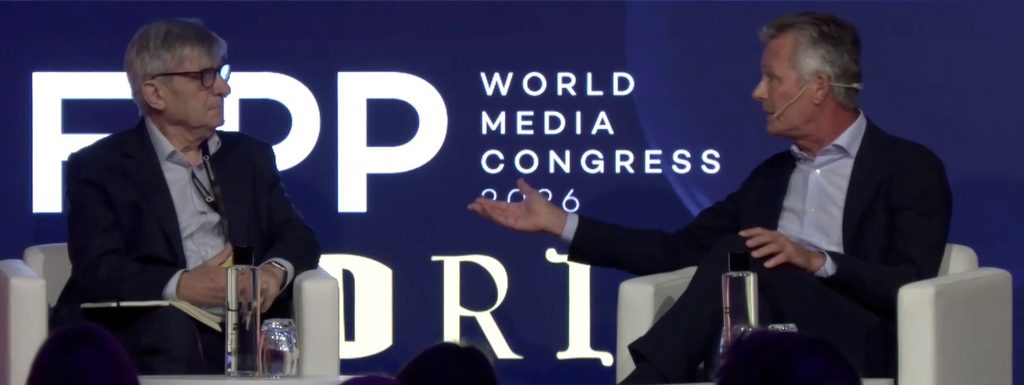
The company has been led for 35 years by Christian Van Thillo, who is now executive chair. During the past decade, DPG has spent more than €2bn on acquisitions including the local operations of Sanoma, and RTL Nederland (which accounted for more than 50% of the total investment). I interviewed Van Thillo, who is chair of the European Publishers Council, this week at the FIPP World Media Congress, in Madrid.
What is DPG Media?
We’re a Belgian-Dutch Company, originally Belgian. Our revenue in 2026 will be €2.4bn, with 45% coming from publishing. We have 11 daily newspapers in the Netherlands and two in Belgium. We have a €250mn magazine business, with 15 primary brands, and 45% of our business is TV and streaming, in Belgium and the Netherlands as well. So we’re really focussed on these two national markets, and, finally, 10% of our business is online services, like price comparison and classified sites.
You have a distinctive approach to managing the business?
When I joined the company – a family business – I was only 27 years old. I was CEO from day one. We were a very small company, basically a €60mn-revenue, lossmaking magazine publisher. We focussed on trying to become profitable and grow our media, which succeeded throughout the 1990s. Then, we started to make acquisitions. And, in making these acquisitions, I always said, “I wouldn’t like to be bought. So let’s be nice to the companies that we buy”. Most of them have management issues, which was not the fault of the other 95% of people who work there. What we did – and we were really, very disciplined about the post-acquisition integration – is that, rather than telling our new people “this is how we do it”, for each acquisition, we have had a six-week exercise with people from every division asking the questions: How are you doing things? How are we doing things? What is best practice? And, now that we’re together, what can we do better? And we’ve done that with all major acquisitions since 2009. When you do that, you build your DNA and you become a more integrated company, maximizing efficiency but also sharing know-how and inspiring each other to become a yet stronger ‘one company’.
Once we decided to transform our company digitally (back in 2016) after all these big acquisitions, we came to the same conclusion. We said “digital transformation is a mindset”. You will only find so many really talented digital people, so why don’t we build a matrix where you have full focus on the brands? For example, for the 3mn subscribers we have in magazines and newspapers, we have just one division that does all the marketing – because we’ve got very good digital people there. That’s how, in 10 years, we went from 5% digital subscriptions to more than 50% in our news media. And that is why we chose to do that, without thinking too much about it; we just thought it was the right thing to do. And, when we bought RTL Netherlands in video and TV, we came to the same conclusion because TV is also being disrupted in a huge way. That’s how we have built a heavily matrixed, unified organization which neither operates country-by-country nor category-by-category like so many others. But the main point about digesting businesses is simply that, sometimes, the acquired company teams have better ideas and better things than you already have.
What’s the best example of that?
When we bought the Sanoma business in Netherlands, with all the women’s and kids magazines, we recognized that they knew a whole lot that our news media didn’t. As a result, we decided, for example, that – for our largest popular news sites – the entertainment content of our magazines was extremely valuable. So we integrated that with some of the news content behind the paywall. Then, we decided to bundle the magazines into subscriptions for the newspapers. And then, when we bought RTL Netherlands last year, the editor in chief of Libella, (our largest magazine in the Netherlands) said: “Christian, there’s going to be great opportunities for us in streaming, because we have this magazine know-how. Why don’t we go into video and do something for our 1.8mn subscribers on our streaming platforms?”
When you build a company like ours, it becomes exciting, because I don’t believe that anyone wants to work for a company that is in decline. Everybody wants to work for a winning company and will respond to being involved in it.
What have been the learnings?
Over the years, the best example of the mistakes we made, was when we went too far in integrating the company. As I said, we have one marketing division, and it has worked very, very well for us, because there’s so much digital expertise you need from building an audience and knowing how to get them to log in. We thought the same kind unified division would work well also for advertising. But it didn’t because the Belgian market is very different from the Dutch, and people plan and buy ads quite differently, not just advertising agencies but advertisers too. So that approach was dead wrong and we had to reverse our strategy on advertising sales, as a result.
Which other media companies impress you?
When the Telegraph was for sale in London, we – along with almost everyone else – looked at it and I was really impressed by their whole approach to digital journalism. They and The Guardian and many of the UK publishers do that very well. As someone at the Guardian said: “The difference in news media between print and digital is that print is all about preparing one great meal a day. But digital is an ever-changing buffet”. That really is the essential mindset for digital journalism: it’s not just one product, it’s 24/7. Of course, the New York Times is very inspiring. I’ve been in this business for almost 40 years and, because I started so young and was new to the industry,I have always been looking for inspiration and have travelled the world to get good ideas. That’s why the DPG focus has always been to become truly multimedia in our geographies. If we can replicate that in other markets, we’d love to do it…
Will you ever expand to other countries?
I’ve never been interested in how big we are. The only thing we look at is: if our strategy works, is there a chance that eventually, we could do something in this or that market that resembles what we currently do in Belgium and the Netherlands?
Are the two countries different to other media markets?
The Scandinavian markets and the Netherlands look alike. But the French market, for example, is completely different. If you try to buy a French company, there will be 20 billionaires before you, all wanting to own a media company, so you’re better not to go there. Or you will end up paying a whole lot of money. So, no thank you. My father lost a lot of money there, by the way. Our expansion into other markets, say Italy or Spain is – in theory – perfectly possible. But these are larger markets. Who knows?
What have been the lessons of DPG’s success?
First, when you decide to reinvent your media and go digital, you have to go all the way, and it has to be a decision for the entire company. It is really a turnaround. It is reinventing yourself, and it’s not something that you do gradually. You will build it gradually. But, in your head, you have to say that’s what we’re gonna do, and we’ll stick to it. So we made that plan 2016 and have realized some kind of dream 10 years later in 2026. There’s a certain point in time when you have to communicate. I mean, we’re 6,200. people and you have to tell your people, ‘now we going to change’. And that’s what we’re doing now in TV, as well, because the disruption is even more brutal than we’ve seen elsewhere.
Second, so many people are making deals with big tech. We all know that we have a frenemy relationship with these platform companies; they’re closer to enemies than friends, to be honest. But I think you must build your own destination and try to be independent. I went to the Google Zeitgeist and I always felt that they don’t care about journalism. Whatever they say, they really don’t. I think they and the others are, unmistakably, an existential threat to our businesses and we certainly need enforceable legislation. But, as companies, we also need to take our own longterm view and not compromise just for a short-term gain.
