




Early next year, the UK-based, family-owned Haymarket Group will celebrate its 70th anniversary and also the 94th birthday of founder, Michael (Lord) Heseltine. The former UK deputy prime minister’s political career was marked by: youthful protests in the parliamentary chamber (waving the ceremonial mace above his head); serial success as a minister who irked civil servants with his determination to make government, well, businesslike; walking out on then prime minister Margaret Thatcher; and his enduring, fierce opposition to Brexit.
But it all began with Haymarket.
It started in 1957 with the Opportunities for Graduates directory. But the company took off with the launch of Management Today which – like Campaign and Accountancy Age – combined serious business writing with the look and feel of luxury consumer magazines. They were full of flair, good writing and innovative design: a taste of what was to come from the fledgling company.
Haymarket people were ultra-competitive, creative and hungry for success. They were an edgy mix of posh Brits and young tigers who recruited the best designers, journalists and sales people.
Having been elected a UK Member of Parliament in 1966, Heseltine became a government minister in 1970. He handed over control of Haymarket, for most of the succeeding 27 years, to his colleagues Lindsay Masters and Simon Tindall who led the company’s spectacular success. The perils of the internet age seemed worlds away in 1999, when the founder resumed control for what might be described as as his third career, at the age of 66.
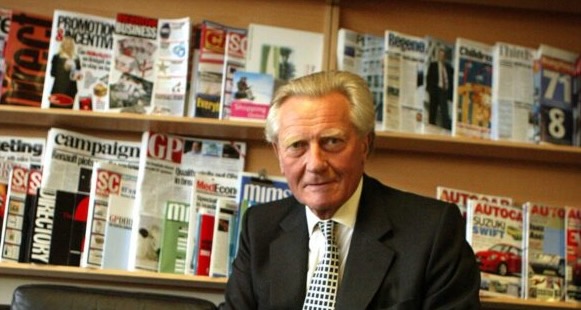
Having been the UK’s ministerial boss of world trade, Heseltine was on a mission to internationalize his own company. Within a few years, it had built a network of some 100 international magazine editions. In 1999, it became one of the first publishers to enter the Indian market ahead of the 2004 repeal of laws which had previously prohibited foreign media ownership.
By then, some 14% of Haymarket’s revenue was coming from outside the UK. And, in 2011, everybody could see what had motivated Heseltine’s global ambitions: Recession and the digital defection of classified ad revenues saw the company’s UK revenues fall to £139.2mn – 25% down in six years. By 2014, total revenue was was £187mn – 18% down on 2005, but international revenues were £67mn (36% of the total), with almost two-thirds from the US.
But things started to get trickier.
UK specialist publishers like Haymarket, Dennis (launched in 1973) and Future (1985) had some great years of high-margin revenues from global networks of licensees which paid to re-use high-quality content in their own newly booming magazine markets. In some ways, the licensing of these specialist magazines, as a rich seam of profit, was obscured by the better-known glossies Cosmopolitan, Harpers Bazaar and Vogue which had pioneered international editions for Hearst and Condé Nast.
But the booming internet started to explode the neat separation of national editions, even though some publishing markets (like India) were still growing. Haymarket’s 2014 pre-tax profits of £11.1mn seemed like a bounce-back from the losses of £7.6mn in the previous 18 months and prompted eloquent words from founder Heseltine: “These figures are a testament to the continued operating strength of the group, the benefits of our recapitalization in recent years and a prudent approach to managing our property and asset portfolio. As a result, Haymarket is well positioned to harness growth opportunities amid an improving economic outlook in its core UK and US markets.”
But, like media companies everywhere, the figures could not disguise the way that digital revenues were growing too slowly to compensate for the rapid decline in print. Over the previous decade, the company had lost large volumes of high-margin classified print revenues to digital specialists. And it was getting worse.
It was a familiar story right across the once-booming magazine industry.
But Haymarket had a special problem which almost wrecked the company. That was the debt-funded transaction with which Michael Heseltine and his family bought back the 49% of Haymarket shares owned by Lindsay Masters, Simon Tindall and long-time finance director David Fraser – for a total price of more than £100mn.
The resulting debt weighed down the company for almost 10 years amid asset sales, closures and redundancies. It made hundreds of millions of pounds of property and publishing divestments as Haymarket put a brave face on what was really a fight for survival. One-time debt levels of £150m almost matched the company’s revenue and dwarfed the profits as the internet slashed print advertising and copy sales.
Haymarket divested more than 20 magazines. But what, ultimately, transformed its fortunes was the £85mn sale of its Thames-side offices and TV studio complex for development as upmarket real estate, in 2014. It had acquired the site a decade earlier for £20mn.
That deal marked the end of a nightmare.
You can imagine how tough it had been for Haymarket lifer, CEO Kevin Costello, to wave goodbye to, say, the motorsport magazines that had almost defined the company for decades. Perhaps even more galling may have been the divestment of the brilliant, all-digital PistonHeads which had been acquired for about £1m (less than what became the annual profits). But an offer of 13x made that sale too a no-brainer. Many of what had been the company’s best-known magazines including Stuff, Gramophone, What HiFi, and Autosport were gone.
But, by 2017, so was the debt.
It’s difficult not to agree with Michael Heseltine’s long-ago assessment of Haymarket as “an admired and innovative publishing business that helped to change the face of British publishing.” In the toughest of times for companies which once depended on printed magazines, it also provided a case study of how – under pressure – you can sharpen the strategic focus, coolly sell-off treasured brands and still get back to investing in quality content.
The endlessly bullish Haymarket moved from being expansive at the start of the 21st century to a needs-must, sell-off and – now – it’s back to the old ways of looking for creative new ways to beat competitors in new media and new markets with a new focus on B2B media, information and events. Only the automotive brands What Car?, Autocar and Classic & Sports Car are left to remind Haymarket people of the years when it had been a star publisher both in B2C and B2B.
But it’s more profitable than ever.
The financials for the year ended 30 June 2026 will show just how comprehensively Haymarket has rebounded, with the highest revenue and profit since it became debt-free in 2017. Another 10-year landmark to celebrate in 2027. It means the enterprise value of the 70-year-old business has never been higher. The highlights of 2025-6 (see table, below) are expected to be:
- Revenue +7% to £187mn, EBITDA +42% to £17mn
- US revenue (principally medical information and events) +9, now 46% of the total.
- UK revenue +6% (+12% in three years)
- Digital is 67% of revenue, led by Development Control Services, the urban planning digital service which had been acquired back in 2003.
- Net cash of £27mn
The medical education network in the US (soon to be rebranded as Haymarket Healthcare) benefitted from a record number of new drug approvals in 2025 which is expected to be exceeded this year. Costello told the Flashes & Flames Monetising B2B conference in May: “In the US, doctors must renew their licenses annually, so we built our own medical education platform and inserted ourselves into that educational workflow. We then expanded into promotional advertising and built a third-party agency business aligned to the pharmaceutical approval pipeline.” Notably, around $50mn of the US revenue now comes from brands that didn’t even exist five years ago, in specialist therapeutic areas.
It seems likely that Haymarket will be marking its celebration year with 2026-27 revenues of more than £200mn for the first time. The growth will be enhanced by the 2025 acquisition of the marketing portfolio from Centaur Media for some £4mn.
The acquisition added Marketing Week, Creative Review and the Festival of Marketing to Haymarket’s Campaign and PR Week. It may have added almost £1mn of annualized profit. That’s before September’s launch of Festival of Marketing Asia, in Malaysia, and possible follow-on launches in India and the US. The legendary Campaign now has 13 international editions at the core of a ‘marcom’ portfolio which accounts for an estimated 35% of the company’s revenue.
Kevin Costello told Monetising B2B 2026 that the future of Haymarket would be “more AI, more international expansion, more diversification and more data”.
As four-year chair Rupert Heseltine, 16-year CEO Costello and the still immersed founder Michael Heseltine prepare to celebrate an eventful 70 years, Haymarket is growing strongly again. Watch out.
| SnapShot Haymarket Media Group | ||||
| £mn Yr end June | 2026* | 2025 | 2024 | 2023 |
| Revenue | 187 | 175 | 183 | 183 |
| UK | 45% | 45% | 43% | 41% |
| US | 46% | 45% | 48% | 50% |
| RoW | 9% | 10% | 9% | 9% |
| Digital | 67% | 67% | 63% | 63% |
| Events | 24% | 22% | 23% | 22% |
| 9% | 11% | 13% | 14% | |
| Ebitda | 17 | 12 | 15 | 15 |
| Margin | 9% | 7% | 8% | 8% |
| People | 1,200 | 1,300 | 1,361 | 1,341 |
