





Let’s be honest: for many publishers 2025 has been tough. The early impact of AI has largely been as a ruthless disruptor, with LLM’s hoovering up vast swathes of copyrighted content and serving it neatly via increasingly helpful chatbots to ‘our’ prospective readers for free. Anecdotally many publishers have reported a big drop in traffic this year, and now we have the data to back it up.
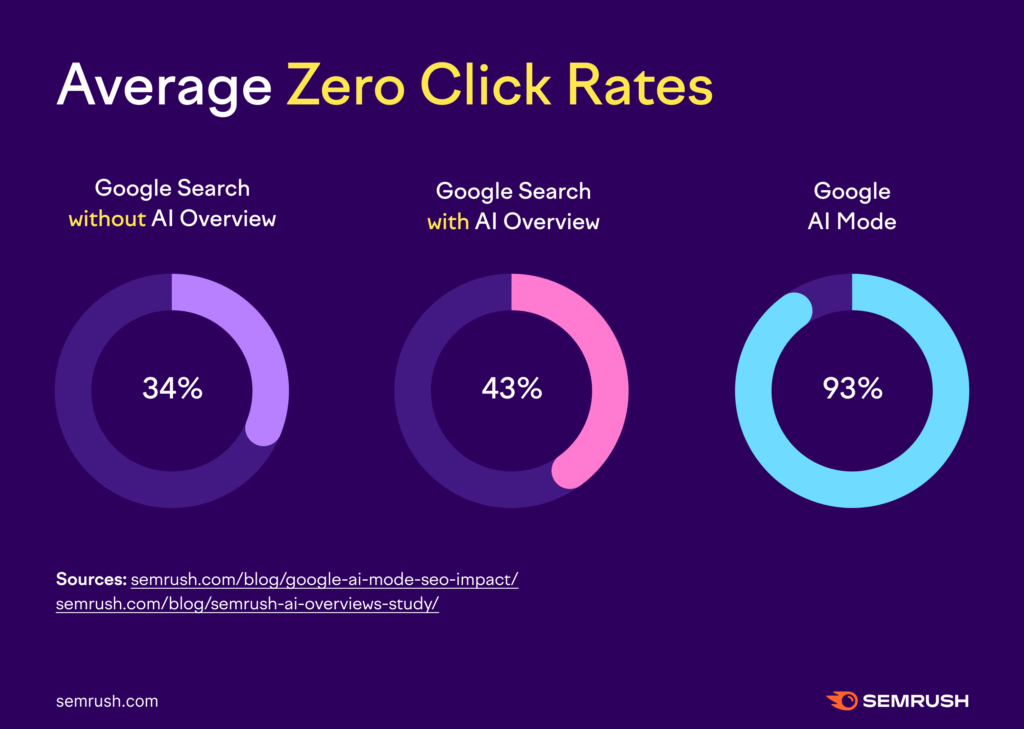
The chart below, from SEM Rush quantifies the existential threat to publisher business models and reinforces the need for traffic diversification and deeper engagement It shows that emergence of AI search (Zero-Click and AI Overviews) has reduced click-through by up to 59%. This is not theoretical: it’s a present-day revenue risk.
Will 2026 be as brutal and as disruptive for publishers as we’ve witnessed in 2025 so far? Or will premium publishers find ways to harness AI tools as an engine for value creation?
I still feel confident that for publishers that act quickly, experimentally, strategically and with big ambition, we’ll see some big winners in the year ahead. In this piece we’ll look at some of the successes that legacy publishers are already seeing, we’ll cover some practical tips that publishers can employ to drive growth and we’ll highlight some of the pitfalls to avoid.
Let’s start with an inspirational story about revenue diversification.
Revenue diversification – Nvidia
What does Nvidia – now a $4 trillion juggernaut – have in common with a 150-year-old publisher? Perhaps more than you might think.
Fifteen years ago, Nvidia was “just a gaming company” making graphics cards for PC hobbyists. When crypto mining boomed, the company pivoted, capturing both planned and accidental revenue from GPUs perfect for blockchain’s parallel computation demands. Most would have been satisfied; Jensen Huang and team weren’t.
In 2006 Nvidia quietly launched CUDA, a programming platform for general-purpose computation on GPUs. It was ignored by most – until a handful of AI researchers realised that CUDA could train neural networks 10–100x faster than CPUs. By 2012, with the seminal “AlexNet” breakthrough, Nvidia was perfectly positioned for the AI explosion. From 2020 to 2024, Nvidia’s revenue mix flipped: what was once 51% gaming is now 88% AI data centre, and cumulative revenue topped $46 billion in one quarter alone. Its $1 trillion market cap doubled, re-doubled and then doubled again – faster than any company in modern history.
Why does this matter for publishers? Because the real Nvidia lesson is that category-dominating businesses aren’t the ones who resent change, fight the last war, or delay hard decisions. It’s those who anticipate disruption and repeatedly, fearlessly, reinvent their role as the environment shifts.
Today’s publishers, media companies and event organisers are standing where Nvidia stood 15 years ago: at the edge of enormous, unpredictable opportunity. The choice is clear – embrace the pivot and exploit new data and AI waves, or watch as market value migrates elsewhere.
The shape of disruption: AI’s effect on Media sectors
1. Newspapers: Fighting for survival, racing for reinvention
Newspapers, long plagued by shrinking revenues a no nd the gravitational pull of platforms, face a paradox: AI is both lifesaver and existential risk.
- The Financial Times exemplifies what transformation can look like. Armed with a team of data scientists and a willingness to break traditions, the FT now leverages machine learning across its subscription funnel: surfacing tailored article recommendations, optimizing paywall timing and even guiding dynamic pricing models based on churn predictions. The outcome? Subscriber growth breaking past the 15% mark in key verticals, and churn losses falling to record lows.
- Reach plc, the UK’s largest national and regional news publisher, deploys generative AI to local news, using natural language models to summarise council meeting transcripts, automate video captioning and unearth hyper-local trends for journalists to investigate. Reach have reported that the newsroom’s AI pilot led to a 22% productivity uplift, freeing editorial teams to chase bigger stories and boosting pageviews by over 30% on AI-enhanced content.
But challenges abound: as mentioned at the top of this piece, many publishers have seen digital traffic dip this year after Google and OpenAI began publishing AI news snippets, highlighting the risk that generative models could disintermediate trusted brands. Some publishers have seen up to a 40% drop in referral traffic from search, sparking fresh urgency for new AI-driven product innovation.
2. Lifestyle Magazines and digital verticals: Adapt or fade
If the newspaper business lives on renewal, lifestyle and vertical magazines are fighting for relevance as digital audiences fragment and platforms squeeze margins.
- Hearst UK is ahead of the curve with its “Ask Good Housekeeping” engine. Built on a custom-trained LLM and Hearst’s own usage data, it delivers AI-generated, brand-safe advice tailored to reader intent – fuelling record web engagement and opening up new affiliate revenue streams. Pilot results show 18% higher click-through than legacy service content. Cosmopolitan’s move into AI-powered social listening has boosted time-on-site by 23%.
- Bauer’s algorithmic content segmentation has allowed for micro-niche newsletter products tailored to reader mood and time of day, doubling open rates among key demographics while algorithmic “taste-makers” curate content that would have otherwise been lost in the archive.
But the risks still loom large: Legacy publishers who attempt to bolt “AI newsrooms” onto brittle legacy workflows will likely only to see traffic and ad yield fall as quality and trust suffer. When algorithms fail to reflect a brand’s editorial voice or ethics, the reputational damage can be swift and severe.
3. B2B Information giants: Quietly dominating
While B2C media has grabbed most of the headlines, it’s B2B information services that may emerge as AI’s biggest winners in the year ahead.
- RELX has gone all-in on AI-powered analytics products, using proprietary datasets aggregated over decades to offer insights in law, science and risk. These platforms now account for a significant percentage of operating profit and churn has been slashed as client dependency deepens. Investors consistently reward RELX with “tech stock” multiples, despite its roots in old-world publishing.
- Informa’s integration of AI into event planning, exhibitor targeting and lead qualification has made it the backbone for marketing automation in the industries it serves. Data-driven customer journeys, shaped by AI, now underpin every major decision from event formats to sponsorship models. High-margin consultancy, advisory and analytics products – not just content or ticket sales – are driving revenue growth.
The Lesson? B2B players with unique IP who bet early on AI-powered productisation are changing the competitive field, while those treating AI as a cost-trimming afterthought find themselves trapped by commoditised offerings, with margins continuing to decline.
4. B2B Events: From networking fairs to Data-driven marketplaces
Live events and exhibitions – once networking playgrounds – are being recast as data marketplaces, powered by predictive intelligence.
- Terrapinn and Easyfairs use AI to build granular attendee personas, enabling sponsors to target high-intent buyers, while driving up cross-sell and upsell conversion rates. Predictive matchmaking engines, fueled by hybrid (virtual/in-person) event data, make each event “smarter” than the last, rewarding delegates with stronger ROI for time and spend.
- AI’s impact isn’t just about tech: It’s also cultural. Greg Hitchen and Anne Lafère argue that event organisers who embrace data-driven workflows and open innovation are outpacing their more traditional rivals. They’ve seen Net Promoter Scores and retention improving 20–40% for events piloting AI across agenda-building, content creation and customer service.
But, of course, there are risks to be aware of. Over-automation can strip events of their human edge. AI should complement rather than replace the live event spark. The best results mix algorithmic prediction with human insight, using AI as a co-pilot for curators and hosts.
Ways to win with AI
What should publishers actually do as AI remakes the landscape?
A. Own (and enrich) proprietary data
- Perhaps the single best predictor of future advantage is exclusive access to unique, first-party data. RELX and Informa’s platforms dominate because their data assets can’t be easily replicated by outside AI tools.
- For publishers, rising consent barriers and looming privacy regulation mean that gathering and enriching first-party user data – ethically and transparently – isn’t just compliance, it’s competitive hygiene.
B. Build trust through transparency
- The age of “black box” algorithms is over for reputable media. FT Strategies and Hearst both emphasise making AI explainable – to editors, readers and regulators. The BBC’s latest AI pilots let users see how recommendations were generated and why they’re seeing what they’re seeing.
- Smart publishers will document editorial involvement and audit trails on AI-assisted stories, building user trust and regulatory goodwill. Global news trust studies show that “explainable AI” can improve engagement and retention scores by 10–15%.
C. Deliver real personalisation (Not just more content)
- Amazon and Netflix-like personalisation is the norm. Publishers must catch up; many already have. The FT, Hearst UK and Bauer segment audiences down to reading frequency, topic clusters and preferred formats – and use AI to test new content types (audio, video, interactive tools) on micro-cohorts before rolling out more widely.
- Immediate Media and major European publishers are moving beyond “content at scale” to “value at scale,” including AI-driven curation of newsletters, bundles, and niche virtual events.
D. Quick wins, iterative learning and scaling up
- The FT, Terrapinn and Easyfairs have all adopted a “perpetual pilot” mentality. Early quick wins, like AI-based video captioning or events matchmaking, build internal momentum and supply fresh data for the next innovation.
- Practical advice: Champions should work cross-functionally, harvest learnings quickly and look to scale pilots into enterprise-level platforms within months, not years.
E. Ethical Foundations – Set the rules before someone else does
- With regulation advancing in the UK, EU and US, and copyright questions looming (a key topic at the Forum’s regulatory sessions), smart companies are investing in copyright and ethics policies.
- A practical approach: form AI steering committees, audit current use cases, and actively engage with policymakers to ensure self-regulation outpaces imposed regulation whenever possible.
Who’s losing and why?
Case 1: Newsrooms that outsourced core capabilities
- Some major global publishers ramped up the deployment of “off-the-shelf” AI tools for content curation and workflow automation thinking it would unlock immediate efficiency. Instead, they lost editorial edge – readers found the blend of AI and human insight unconvincing, and click engagement dropped by double digits. The lesson: Use AI as a co-pilot, not as a substitute pilot.
Case 2: Weak data, weak defences
- Media companies with limited or unstructured data often find themselves late to the AI party. Sadly we’ve seen some smaller publishers, unable to invest in proprietary pipelines, swiftly outpaced by more data-mature competitors. A robust DMP and active data governance are as crucial as the AI application itself.
Case 3: Ethical lapses and brand erosion
- Quick-and-dirty implementation of AI-generated content without clear labeling or oversight has led to regulatory censure in Europe and a backlash from core audiences. Those transparent about process – and about AI’s limits – emerge with higher trust, while others face lasting brand erosion.
Practical checklist
Immediate next steps:
- Audit current AI usage and data assets: Are workflows, content, or audience segments automated already? Where could proprietary value be added?
- Build a cross-functional AI team: Editorial, product, tech, data and legal specialists working on rapid pilots – think “sandbox” before “factory.”
- Create an AI ethics and transparency framework: Publish it, update it, own it.
- Activate three “quick wins” in AI: Content enrichment, automated marketing workflows, and reader/delegate personalisation.
- Join consortia or engage with policymakers: Don’t go it alone – regulation will arrive; best fight its corner with peers.
Longer term:
- Grow exclusive data: Invest in unique IP, proprietary datasets, and segmentation that can’t be easily replicated.
- Foster ongoing experimentation: The pace of AI innovation will only accelerate. Build a culture of test, fail, learn and scale.
- Keep AI visible, never opaque: Both to teams and to audiences.
- Prize AI fluency – not just among technologists, but editorial and commercial leaders.
- Link AI adoption to value creation, not just cost-cutting.
In sum: The next five years will be the most inventive, unpredictable and potentially rewarding for those in media and events willing to move at pace.
The media world’s future belongs to doers, not watchers; to brands that see AI not as a threat, but as the latest and most powerful tool for radical reinvention.
The winners in the AI era won’t necessarily be the most established, but the most agile – the ones who see challenge as signal, not noise. Like Nvidia, media leaders can use today’s turbulence as tomorrow’s springboard. The future is here. Let’s not just survive it – let’s master the reinvention.
