





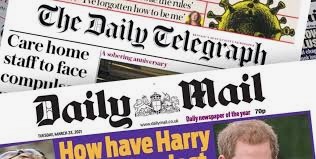
The Daily Mail publisher, the privately-owned Daily Mail & General Trust (DMGT), has signed an agreement with RedBird IMI to acquire Telegraph Media Group for £500mn, (£400mn upfront and £100mn after 12 months). DMGT said it is now in a period of exclusive talks with the Abu Dhabi-backed venture over the sale of the Telegraph, to “finalise the terms of the transaction, and to prepare the necessary regulatory submissions”.
DMGT owner Lord Rothermere said: “I have long admired the Daily Telegraph. My family and I have an enduring love of newspapers and for the journalists who make them. The Daily Telegraph is Britain’s largest and best quality broadsheet newspaper, and I have grown up respecting it. It has a remarkable history and has played a vital role in shaping Britain’s national debate over many decades. Chris Evans is an excellent editor-in-chief and we intend to give him the resources to invest in the newsroom. Under our ownership, the Daily Telegraph will become a global brand, just as the Daily Mail has.”
That hints at the way the Telegraph and Mail together will seek to build digital subscriptions on both sides of the Atlantic and exploit what many – including RedBird – have seen as the opportunity to build a major conservative news platform to rival the liberal New York Times. DMGT might expect encouragement from the Trump administration.
The Mail, which has been a leading international digital news site for more than a decade, has recently been building paid-for subscriptions (reportedly 350k so far, with a 2028 target of 1mn). The Telegraph-Mail may become a formidable combination for that strategy at a time when virtually all UK national daily news brands are working hard to grow US audiences and revenue, most successfully by The Guardian.
DMGT – which already co-owns (with News Corp) the Telegraph’s printer and also sells its advertising – had previously intended to acquire a minority stake of 9.9% in the Telegraph, as part of a RedBird-led consortium. This plan was believed to include the kind of subscriptions marketing collaboration that will now be at the centre of DMGT’s strategy.
It is almost two years since RedBird IMI attempted to seize control of the Telegraph by paying off the Barclay family’s overdue debts to Lloyds Banking Group. That derailed an auction but was blocked in April 2024 following a political outcry over fears of foreign influence in news media.
The DMGT news was a Saturday morning surprise to most observers, although the speed of some kind of deal was not. Ultimately, the deal – if approved – guarantees the Telegraph’s future under the ownership of what is the UK’s most successful daily newspaper group. For Telegraph employees, it may seem like the best possible outcome, despite the inevitable rationalisation involved in bringing together two daily news groups.
The Financial Times said: “The deal has been struck at about £500mn, which would repay the money spent by the RedBird-fronted consortium on the newspaper. The parties have entered a period of exclusivity to finalise the terms of the transaction. A merger of the Daily Mail and the Telegraph would redraw the traditional lines of Britain’s Fleet Street, creating one of the largest UK media groups and a dominant voice in rightwing politics at a time when the Reform party is growing in popularity against the leftwing Labour government. Any deal will face questions over competition and media plurality, given it would further consolidate ownership of Britain’s national newspapers under a single proprietor.”
The Telegraph itself, whose journalists had been openly critical of RedBird, said: “Lord Rothermere had lined up as a minority investor alongside RedBird and the UAE, and… has longstanding business connections in the UAE via its oil and gas information arm (its fast-growing DMG Events subsidiary).”
But one “Telegraph source”, quoted by The Times of London, was more cautious: “There will definitely be some discomfort in the newsroom at the idea of being bought by the Mail but, ultimately after two and a half years of limbo, everyone wants this to be over. Rothermere says he’ll give us the resources to invest in the newsroom. I just hope he can follow through on that promise.”
DMGT said the proposed deal would comply with the UK’s newish regulations on foreign state influence because “there will be no foreign state investment or capital in the funding structure”.
The seemingly speedy deal (albeit that it may yet be subject to a competition review) will be a relief to RedBird Capital.
If the UAE-US owned RedBird was looking for a way to justify the decision to withdraw its own £500mn bid for the UK’s Telegraph Media Goup (TMG), it got it earlier this week with parliamentarians calling for the government to take control of the sale process. It had become all too political.
A succession of RedBird blunders – that have included giving exclusive negotiating rights to a New York-based bidder without checking whether he had the necessary funding (he didn’t), clumsy whispers about replacing the editor-in-chief and clumsier still evasive answers about the sources of its own funding – have been buried by the avalanche of criticism by politicians and the Telegraph’s own journalists.
The upshot is that – for all the talk about a new bidding process in 2026 – RedBird cannot wait to rid itself of its Telegraph obligations while recouping as much as possible of the £500mn it had paid for the call option to acquire TMG. That’s why the film-TV-sports media investor, which always seemed an unlikely acquirer of the Telegraph, is believed to be trying to secure a speedy resolution with some of the companies and individuals previously involved in the bidding.
This week, RedBird CEO Gerry Cardinale said he was committed to “find the right owner… given the current circumstance”. But he now knew that, failure to get even his exit deal done quickly, would risk RedBird being shut out of the whole process.
The proposed deal will involve some level of regulatory review and might yet lead to DMGT divesting its i and/or Metro tabloids – a small sacrifice. But many politicians (and not just Conservative supporters of the Telegraph) will support the acquisition because of the certainty it offers to one of the UK’s oldest newspapers.
DMGT said it was “confident any regulatory process can be concluded swiftly and positively” and that “today’s media landscape is unrecognisable from a decade ago. News publishers have to compete against both vast global online platforms and myriad digital and social media news sources, some of them highly unreliable.”
RedBird’s on-off auction debacle has anyway had the effect of making a DMGT acquisition much less controversial on competition grounds than it previously would have been. Given the alternative (a further protracted search for a new owner of the Telegraph), the Daily Mail deal may be broadly welcomed – and swiftly approved. After all, to judge by the tortuous events of the past 24 months, there are few other companies prepared to meet anything like RedBird’s £500mn valuation.
The Daily Telegraph has had a remarkable history.
It was launched as a four-page broadsheet in 1855. Its early history was punctuated by curiosity and innovation. In the 1870s, it co-sponsored an exploration to the Congo which had Henry Morton Stanley greeting David Livingstone with the now famous: “Doctor Livingstone, I presume?”
In 1925, it became the first UK national daily to publish a crossword puzzle which, during World War 2, led to the recruitment of code-breakers for Britain’s Bletchley Park intelligence base. The newspaper had agreed to organise a crossword competition, after which the successful participants were recruited to the wartime intelligence services. In 1935, the paper was the first in the UK to own a television set and its “wireless correspondent” started to cover the fledgling TV, almost two years before the BBC made its first regular broadcasts.
In 1939, it scooped the world with the news that Germany was about to invade Poland. Almost half a century later, in 1994, the Daily Telegraph launched Europe’s first web-based daily newspaper, even though the internet was still in its infancy with as few as 10,000 web sites and 600,000 British users.
Despite a succession of ownership changes, the paper has long been the UK’s biggest-selling “quality” newspaper with a slightly uneasy blend of solid news, right-wing political comment, and distinctively detailed reporting of the most salacious criminal cases. The publishing company itself has sometimes seemed slightly unworldly, something other than a business. In the 1970s, then proprietor-chairman Lord Hartwell was a remote figure who (although driving to the office in a battered mini) was attended by two butlers in his huge office. In addition to a suite of panelled rooms – containing maps of the world as it had been in 1914 – it included a turfed area known as the “Hartwell Lawn”.
The unreality came into focus when the paper blew £140m it didn’t have on new printing plants in London and Manchester. The upshot was that, in 1985, Hartwell was all but forced to sell a 14% share to Conrad Black, a Canadian who was putting together what became a global daily newspaper empire.
The sleepy Brit consoled himself by thinking he would remain in control of the newspaper which had been owned by his family for the previous 70 years, simply because he would retain the title of chairman. But he was said not to have understood either the detailed provisions of the new shareholder agreement – or the financial pressures bearing down on his newspaper. Within 12 months, it needed a further cash injection. It gave Black the opportunity to take control before, eventually, acquiring the rest of Hartwell’s family shares.
Conrad Black’s control of the UK Daily Telegraph ended in 2004 when he was dismissed by his own parent company amid allegations of financial wrongdoing. He was eventually imprisoned for three years in the US. Meanwhile, the Telegraph Media Group was acquired (for a UK newspaper record) by David and Frederick Barclay who had beaten off bids from private equity and from Richard Desmond (whose then Daily Express was the Telegraph’s printing partner).
The acquisition highlighted the stunning rags-to-riches success of the one-time candy shop-owning brothers who had reputedly amassed a fortune of billions through hotels, shipping and retailing. Variously described as “secretive” and “reclusive”, the industrious brothers achieved some kind of media notoriety through not much more than being able to avoid photographers.
They came to prominence in the 1990s by acquiring London’s legendary Ritz Hotel, the ill-fated European newspaper, and The Scotsman daily in quick succession, a decade before splashing out on the Telegraph. Their deals were much more visible than the brothers themselves. They lived and worked – away from prying eyes and journalists – in a mock gothic castle on Brecqhou, in the Channel Islands (a UK tax haven island off France). In 2004, the mysterious new Telegraph owners certainly started to worry Brits who became unsure whether the departure of the imperious Conrad Black was good news after all.
The Barclays promptly recruited Daily Mail CEO Murdoch MacLennan, one of whose first actions was to extricate the company from an expensive pension stoush with spikey print partner Richard Desmond – by transferring the Telegraph printing to Rupert Murdoch’s News Corp UK. It was just the start of a wild ride of upheaval (the newspaper had seven editors-in-chief in 13 years) and allegations that negative stories about HSBC were being “actively discouraged” following the bank’s 2012 refinancing of its £240mn debt for Yodel, a loss-making Barclay-owned delivery business.
But the newspaper made record profits and also scored some of the UK’s best investigative journalism of recent years including: the expose of the sometimes outlandish expenses of members of parliament, which led to high-profile convictions; and alleged financial misconduct in soccer-football which led to the 2016 resignation of the England national coach.
But that was before the Barclay brothers’ debt-funded investment spree caught up with them, the Telegraph and, latterly, with RedBird. The nightmare may soon be over.
- The proposed Telegraph sale is the latest planned deal in UK media. Earlier this month, Comcast (US owner of the pan-European Sky TV) said it was in talks to acquire ITV, the country’s largest commercial broadcaster for some £2bn.
