





Rupert Murdoch created the first multinational, multimedia business, and RX (formerly Reed Exhibitions) created the first international trade show company. Both date back to 1969, when Murdoch arrived in London to acquire the News of the World and The Sun, the eventual springboard for News Corp’s transatlantic expansion.
It was the year that Cahners, the US-based B2B magazine publisher, acquired its first trade show business on the way to industry leadership in 1980 with revenue of $90mn. By then, Cahners had become a subsidiary of the UK-based media conglomerate Reed International (now RELX) and the first broad-based exhibition organizer on both sides of the Atlantic. It was the clear market leader in a scarcely-recognized sector.
In the mid 1990s, Reed took what seemed like a radical step – in the US and UK – of separating its exhibitions from the B2B magazines which had largely created them. It proved to be a far-sighted move which established UK and European companies as trade show leaders and RX as the world champion.
That’s how it remained until 2018, when Informa arrived.
Having acquired no fewer than 10 companies and tripled its trade show revenue in Stephen Carter’s first five years as CEO, Informa became the world leader by swooping on the £4bn UBM.
After three decades as market leader, RX had become no.2.
Eight years later, Informa has almost double the trade show revenue of RX which has some 10% market share. But much has changed. Look at the financials (below) and you can see the transformation of RX which – in pre-pandemic 2019 – had £1.3bn revenue but which operated more than 500 events, employed 4,600 people and – consequently – had an operating profit margin of just 26%.
Fast forward to 2025 and the company had £1.2bn revenue, a 35% operating margin, 3,400 employees and 274 events, without the long tail. We forecast that, in 2026, RX will match 2019’s £1.3bn revenue but will make operating profit of £450mn – about one-third more – with 35% operating margins that are ahead of Informa and Clarion.
The performance under six-year CEO Hugh Jones (ex CEO of Accuity banking data) has quietened speculation that RELX – the £10bn-revenue data and analytics group – will divest the trade show business which happens to be its smallest division, accounting for 13% of total revenue.
In fact, RX’s increasing investment in data revenue, technology and AI may be making the best use of the one-third of RELX’s 37,000 employees who are technologists. Jones’ insistence that visitor-user revenue is a significant growth area (it’s currently 26% of the RX total) chimes with the subscriptions-intensive RELX.
Anyway, what would RELX – with its consistent 7% revenue and 10% profit growth, 40% EBITDA margin, 15% return on capital and 99% cash conversion – do with the mere £6bn ($8bn) that RX could be worth?
But even the high-performing RELX of 17-year CEO Erik Engstrom – with an enterprise value of £54bn ($74bn) – might one day be pressured by shareholders (or tempted by private equity) to de-merge or breakup its diverse, US-dominated professional, scientific, business and legal portfolio. It’s all currently unified by technology skills and resources.
The cold fact is that – despite RELX’s impressive growth record – its share price has fallen 26% in the past year, rocked by investor fears of the AI impact on its legal information (the second smallest division) which has actually achieved the best revenue and profit growth this year and last. By contrast, the touted AI ‘safe haven’ of live events (which has, incidentally, buoyed Informa’s share price) might just make RX people feel more secure.
Maybe that will even persuade the parent company to support some substantial trade show M&A, virtually absent from the RX performance since the £200mn ($255mn) acquisition of Mack Brooks in 2019.
Hugh Jones’ data background is especially strategic at a time when trade shows must master the tech to maximize measurable returns for exhibitors and visitors. This week, we spoke to him about the progress of RX:
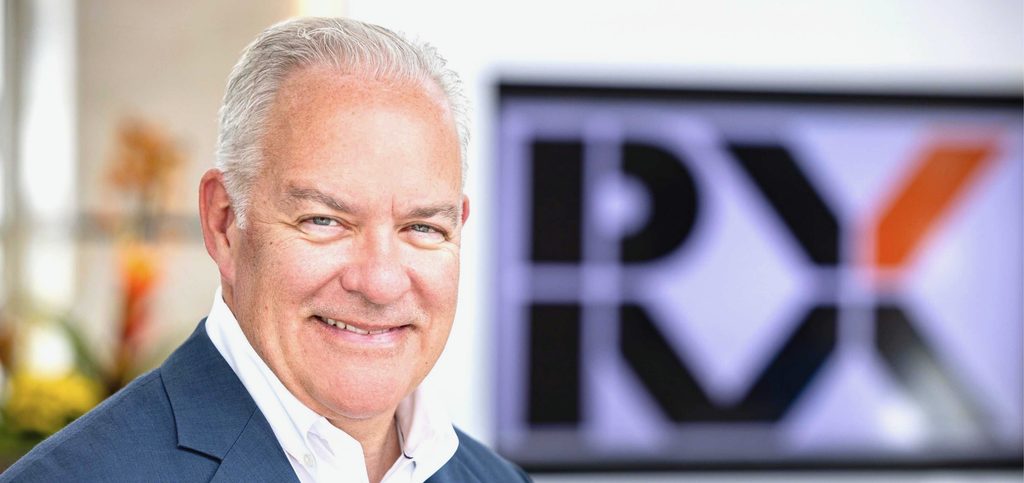
How was 2025 for RX?
It was a standout year for us. We delivered 8% underlying revenue growth and 9% underlying adjusted operating profit growth, reflecting the strength of our event portfolio and the greater value we are creating for customers.
In the Middle East, the Arabian Travel Market, in Dubai, welcomed more than 55,000 attendees from 166 countries, an increase of 16% year on year, while exhibitor participation grew across the Middle East, Asia, Europe and Africa. We also took an important step into Saudi Arabia with the launch of FIBO Arabia, in Riyadh. Its inaugural edition attracted 12,399 visitors from more than 40 countries, demonstrating both the international appeal of the Saudi market and the growing importance of health, fitness and wellness.
Globally, we saw strong performances across travel, energy, manufacturing, beauty, jewellery and entertainment. World Travel Market (WTM), in London, facilitated more than 40,000 meetings – up 16% year on year – while International Luxury Travel Market (ILTM), in Cannes, hosted more than 100,000 meetings. New York Comic Con welcomed more than 250,000 fans.
The numbers matter. But the bigger story is the value created. Our customers generated more qualified leads, formed new partnerships and entered new markets. Increasingly, they see us as a strategic growth partner.
What’s been the lasting impact of Covid?
The years immediately following the pandemic were defined by reopening and considerable deferred demand.
Today, the market has normalised, but it has also become more sophisticated.
Customers are more selective about where they invest their time and money. Attendance and square metres remain relevant, but they are no longer enough. RoI has become central: Did they meet the right people? Generate valuable leads? Find a new supplier? Enter a new market?
That has moved the industry from a focus on volume towards a focus on value.
RX has evolved from being primarily an organizer of events into a business that creates environments for growth. The face-to-face event remains at the heart of that growth. But we increasingly support customers before, during and after the show through data, digital products, personalized recommendations and better matchmaking.
AI plays a big part in how we’re making events smarter and better for our customers, but technology is not replacing human connection; it is simply making it more productive. The strongest events today combine trusted face-to-face marketplaces with data-driven insights, memorable experiences and measurable commercial outcomes. It’s the combination that matters.
What about new events?
Across RX, we launched 10 new events in 2025 and expect to have launched 18 in 2026, our highest number since the pandemic. The portfolio is deliberately varied. Our 2025 launches included MIP LONDON, an international content and networking market for the global television industry; FIBO Arabia, a health, fitness and wellness event, in Riyadh; and Expo Nacional Ferretera CDMX, serving Mexico’s hardware, electrical and construction industries.
Our 2026 launches are equally diverse.
They range from BookCon, a fan-focused celebration of books and storytelling. in New York, to Fac Tec China, focused on smart and sustainable factory technology for electronics manufacturing, and DIY CON, an immersive event for DIYers, makers and creators in Dallas.
ITWA Vietnam is another strong example. It demonstrates the China Hub’s ability to drive international growth beyond China by extending our established strengths in electronics, automotive and advanced manufacturing into Vietnam, creating a new route to market for customers expanding in the region. Developed and launched in under eight months, the first edition secured 1,500 sq m of on-site re-bookings for 2027, providing encouraging early evidence of demand and a strong platform for further growth.
Beyond those launches, one of my favourite examples of our approach to innovation is the PGA Show, in Orlando. It celebrated its 73rd edition in 2026 yet continues to create new markets and opportunities.
In 2025, the PGA Show attracted more than 33,000 golf industry professionals and over 1,000 exhibiting brands, making it the largest edition in 15 years. The Clubhouse, which brings together fitness, health and wellness, racquet sports and club amenities, doubled in size as golf facilities looked for new ways to diversify and grow.
We built on that momentum in 2026 by introducing a dedicated racquet sports experience, featuring full-sized pickleball and padel courts and more than 60 brands. We also co-located the inaugural Functional Fabric Fair Winter with the PGA Show, connecting golf, outdoor and activewear businesses with a curated marketplace for responsibly sourced, high-performance fabrics and textile technologies.
It was a natural fit: Functional Fabric Fair grew from a raw-materials, sourcing area first introduced at the PGA Show in 2016. We also piloted RX NOW, a mobile platform designed to help attendees plan their visit, discover relevant exhibitors and get more from their time at the PGA Show. More than half of the event’s 34,000 attendees used the platform, while visitor-initiated digital leads doubled. Use of Colleqt QR, which allows attendees to scan exhibitors’ QR codes and instantly save product and supplier information to their phones, tripled.
PGA is a good example of RX’s approach to growth and innovation. It is not simply about launching events or making existing shows bigger. It is about spotting where industries are moving, bringing new communities together and creating opportunities that deliver measurable value for our customers.
What about the Middle East now?
We hosted five standalone events across Saudi Arabia and the UAE in 2025 and expect to host nine in 2026. There is no doubt that this has been a difficult year for the region, and we have worked very closely with our customers, partners and stakeholders on the ground before moving forward.
But we also believe that, when it is safe to do so, there is a value in bringing the industry together. Periods of uncertainty are precisely when businesses need strong relationships, trusted information, and the opportunity to talk directly to their customers and partners. Events provide such environments.
We have, for example, recently concluded the inaugural WTM Spotlight Riyadh. Designed to bring together international and regional tourism leaders, the event explores Saudi Arabia’s rapidly-expanding visitor economy. Its three-day conference covers investment, outbound travel, luxury tourism, mobility, talent and AI, alongside Saudi Vision 2030, the Kingdom’s national strategy to diversify its economy and develop sectors including tourism. It demonstrates how we are creating focused marketplaces around the opportunities shaping the region’s future – and reflects our long-term commitment to it.
| SnapShot RX Global | |||||
| £bn | 2026* | 2025 | 2024 | 2023 | 2019 |
| Revenue | 1.3 | 1.2 | 1.2 | 1.1 | 1.3 |
| Growth | +8% | +8% | +11% | +30% | +6% |
| Europe | 36% | 42% | 38% | 40% | |
| US/Can | 20% | 19% | 20% | 20% | |
| RoW | 44% | 39% | 42% | 40% | |
| Exhibrs | 74% | 74% | 72% | 72% | |
| Visitors** | 26% | 26% | 28% | 28% | |
| Op profit | 0.45 | 0.41 | 0.39 | 0.32 | 0.33 |
| Growth | +9% | +9% | +31% | +97% | -1% |
| Margin | 35% | 35% | 32% | 33% | 26% |
| Acqns | — | 0.02 | 0.07 | 0.01 | 0.25 |
| People | 3.4k | 3.4k | 3.5k | 4.6k | |
| No. events | 274 | 282 | 254 | 500 | |
