



Australia could once claim to be the world’s most successful magazine market. Although its population was a mere 19mn in 2000, many of its largest magazines were read by more than 50% of all Australian women. Its largest publisher often had higher profits and margins than its equivalent in the 58mn-population UK. Cosmopolitan, once the world’s most successful magazine with more than 50 editions, had its highest profit margins in Australia.
This was the magazine-mad market in which Jed White – who had been programming computers since he was eight years old and dropped out of university – became a self-taught journalist. At age 23, he became editor-in-chief of Australian Personal Computer (APC), the country’s first and largest ‘micro’ magazine which had been launched in 1980 – before either of the US world-beating brands PC Magazine and PC World.
But magazines are not what they were.
Poignantly, the collapse in Australian magazine fortunes has been even more dramatic than in, say, the US and UK. Of the 20 bestselling Aussie magazines in 2000, 50% (10 brands) have closed. The number of equivalent closures for the US and UK are just three and five respectively.
Now, APC – never one of the country’s 20 largest circulation magazines – is closing after 46 years. The UK-based Future, which has published APC since 2018, has announced its closure of all print magazines in Australia. The news has triggered a wave of emotions from journalists and readers, including from Jed White who edited the magazine from 1994 to 1999 and was Publishing Director of ACP Tech. He is co-founder and CTO of the five-year-old Andi, the first AI-native search engine, venture-backed and based in San Francisco. It has been named Best Free AI Search Engine for the third consecutive year by PCMag.
Jed White farewells a 46-year-old legend.

In loving memory of APC, 1980-2026
The world’s longest-running English-language PC magazine started from a post office box in Melbourne and ended when AI ate its owner’s search traffic.
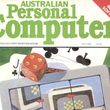
APC was born as Australian Personal Computer magazine in May, 1980 – with a cover story about AI. It passed away as the world’s longest-running English-language computer magazine on October 22, 2026. The cause of death was plummeting publisher search traffic due to AI. Forty-six is young for a person. But it’s old for a magazine. It departed as it lived, inspiring enthusiastic techies.
The magazine first came into the world from a post office box in Carlton, Melbourne, phototypeset and laid out with wax. Sixty pages for A$2.20. The proud father was Sean Howard, a 20-year-old a University of Melbourne medical-school dropout and self-described geek. The mother was the one-year-old UK’s Personal Computer World, which he licensed from Felix Dennis.
This was May 1980. Mainframes ran the world, confined to what Howard called “staid occupations in defence departments, university laboratories and large corporations.” The IBM PC was 15 months away, the Macintosh four years, the web 11. Australia was the lucky and complacent country: more than 70% of its export income came from resources and agriculture. Howard’s editorial bet on innovation. “Australians should recognize the potential for innovative software,” he wrote, “and strive to establish an international reputation in this field.”
But Howard had a real struggle financially in the early days. It took three years before he even first thought it might work. Advertisers were incredibly reluctant early on and they were selling the ads for A$200 each for a full page, and it was hard to convince even people advertising in places like Popular Electronics that computer magazines would be a thing. He’d started it with just A$2,000 working at home, with money saved from unemployment benefits. His family didn’t have any money and he didn’t have any money. He also thought it would just be a short-term thing, and he’d end up going back to med school.
There was a day when he was doing payroll and bills in mid 1983, and for the first time there was money left over.
Howard later said that he wasn’t that into computers until he saw a Commodore Pet in Europe. Before then he really did think they were all big boring mainframes. He was astounded when he saw his first PC. He describes himself as a geek though (and now “an old geek”).
The first issue featured Sue Eisenbach’s Benchtest of the Compucolor II, chess master David Levy’s series on programming computers to play games (billed on the cover as “Artificial Intelligence Without Tears”), and a 10-part Pascal course. The mix included both licensed and Australian content from the start: Howard’s editorial, Miriam Cosic’s Education Report on computers in Victorian schools, local news, a buyer’s guide, a Programs section paying readers A$20 a listing, and dealer ads from Melbourne and Sydney. The local share grew. By November, distributors asked for the print run to be doubled.
I was in primary school when APC first appeared. My grandad had a Commodore PET with games like Mike Mayfield’s Star Trek and Blackjack. My Dad would take me to work on weekends so I could play on the Wang minicomputers with their beige-cased green-screens and clickety keyboards. Then one day, my Dad brought home one of the first issues of APC. I was hooked. Together we’d type the BASIC program listings out of the back of the book. He kept a manila file of articles clipped from the magazine every month. Enthusiasm for technology always was infectious.
In high school, I’d jump off the train home and dash to the newsagent at the station. The sweet days it appeared, I’d run home in a sweat and read every article five times. I had a poster of Silicon Valley on my bedroom wall instead of The Clash or Joy Division. By 12, I was selling dinky games I’d written on floppy disks at hobby meetups. The Computer Club at school met in a dark smelly basement, packed with Apple II computers and their 12-inch green monochrome screens. Copies of APC littered the tables and desks, and were propped up next to the monitors.
Howard sold his Computer Publications company to Kerry Packer’s mighty Australian Consolidated Press (ACP) in 1992. ACP was Australia’s biggest magazine publisher, the company behind the legendary Australian Women’s Weekly and many others. Packer was Australia’s richest man and owned the dominant Nine television network.
I doubt Packer ever read a copy of APC, but it taught him a lesson anyway. Howard kept one thing out of the deal: Microtex, his dial-up service, which became OzEmail. Malcolm Turnbull, who had earlier been ACP’s Corporate Counsel, and later became Australian Prime Minister, put in A$500k. According to Forbes Australia, Turnbull recalled that Packer later turned down an offer to invest in OzEmail, dismissing the internet as a fad that would only be used for gambling and pornography.
OzEmail would eventually list on NASDAQ and WorldCom bought it for A$520mn in 1999. Not many people got one over on Kerry Packer.
After the acquisition by ACP, the computer magazines sat on Level 6 of Packer’s imposing but shabby Park Street, Sydney building, a law unto themselves. I’d dropped out of the University of Sydney for a cadetship, starting on PC Week. My first desk was a packing crate. I had a kitchen chair and had to borrow a computer to write on from a PC company. The editor chain-smoked. I loved it. At 23, I became editor of APC.
Then the web arrived.
The late Mike Udabage, a kind and wise man who was a 20-year ACP veteran, was sent to tame the wild bunch of tech cowboys and girls on Level 6. Instead, he gave us cover to run an intrapreneurial skunkworks, and took the heat on costs from senior management.
We went all-in on the Internet and editorial integrity. We set up ACP’s first internet connection and email and, in 1994, we launched its first website. Cheaper competitors rehashed overseas content, and for years so had we, licensing from US titles including Byte and PC Magazine. The web made that pointless. We built the largest testing labs in the southern hemisphere and moved to 100% Australian content, with a religious mission to put readers ahead of advertisers. In September 1996, we pioneered a three-way model of print, cover CD and a network of websites, including 24 hours tech newswire, and CD Week, the world’s first weekly magazine on CD.
It worked.
By 1999 circulation had more than doubled to over 72,000 audited copies, with hot issues in the high 90,000s. More than 300,000 people read it every month. The website had half a million users a month. Revenue flowed in, with some issues carrying more than 150 pages of advertising, along with bound catalogue inserts and web ads. It was so fun, I’d have done it for free. We started helping the women’s magazines in the building to get online.
Management noticed.
Packer’s son James convinced him to take online media seriously. In a 2000 Rediff interview, Kerry said: “The fact that I have entered into IT-related business is proof that businesses have to evolve and keep with time. One has to re-invent continuously.” He also backed James’s view that “Internet is like electricity. The latter lights up everything, while the former lights up knowledge.”
The internet gave APC and ACP its biggest boom. But, in the end, it killed the whole class of magazines, starting inside our own company. ACP became PBL (Publishing & Broadcasting Ltd), Packer’s listed TV-and-magazines company, and put the titles’ online rights into ninemsn, a Microsoft joint venture, then spun it into the newly-listed Ecorp. The magazines lost control of their websites, and their online destiny. The Microsoft association risked the computer titles’ credibility and independence. I left for startups in 1999. My friends at ACP told me I had rocks in my head.
Kerry Packer died in December 2005. In 2006, his son James shrewdly but unemotionally sold half the media business to private equity firm CVC in a deal valued at A$5.5bn, and most of the rest within two years, at the top of the boom, on cheap debt, before the financial crisis.
In September 2012, the company, then known as Nine Entertainment, sold ACP Magazines to Bauer Media Group, of Germany, to pay down its debt. Weeks later, CVC’s A$1.8bn was wiped out by the lenders, Reuters reported, the largest loss on a single private equity deal in Asia. Bauer sold APC to Future plc in 2013. The UK-based publisher absorbed competitors PC & Tech Authority in 2018, and then merged APC with TechLife in 2022.
By 2017, the apcmag.com website stopped serving content, and redirected to PDF downloads on Future’s TechRadar. The magazine that was one of the first large-scale online publishing ventures, and helped build the searchable web, was gone from it.
Now, the print magazine is going too.
Phil Sim at Influencing broke the story that Future would close all its Australian print magazines the same month it cut staff at its web brands for “the decline in search.” Press Gazette tied the web-brand cuts to Google’s AI Overviews.
APC editor Ben Mansill, in charge since 2018, confirmed the closure: “I’d hoped APC would last a little longer, but the world is changing so quickly.” Subscriptions “were holding up pretty well too,” Sim said, “so it does tend to come down to advertiser support.”
Issue 564, dated November 2026, is on sale now. No final issue has been announced.
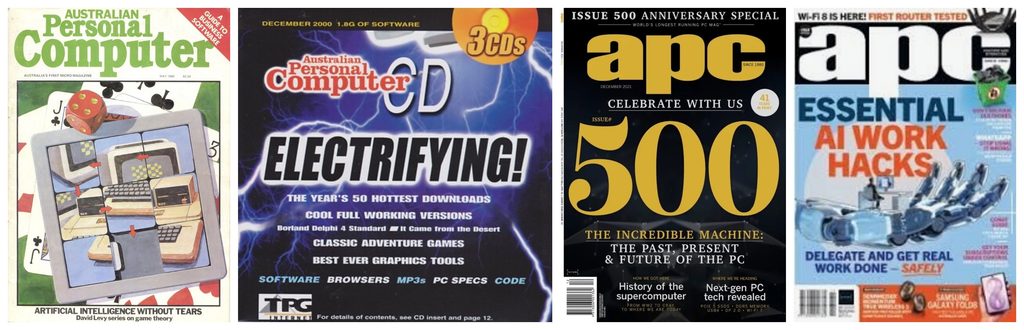
The magazine that opened with “Artificial Intelligence Without Tears” on its cover 46 yeas ago was finally killed by AI.
Founder Sean Howard’s 1980 editorial had asked Australians to build software for the world as a young tech founder. APC was a startup, and so was OzEmail. Y Combinator would back him today. He would have fitted well in Silicon Valley. As for the kid with the poster, I’m in San Francisco, building an AI-native search engine startup, and trying to fix some of the damage AI and Google have done to publishers.
APC is survived by its readers, and the many talented souls who worked there over 46 years. Many got their start there. Roulla Yiacoumi, who joined us straight from her journalism degree, wrote: “APC was the first magazine I ever worked on after completing my journalism degree … RIP, APC, you were the real deal.” The Melbourne blogger behind decryption.net.au has scanned close to 3,500 old magazines and books for the Internet Archive, many of them APC, because “it may as well be scanned first before it gets pulped and turned into toilet paper.” The Archive’s APC collection holds 432 items.
Today’s tech press, Wired and TechCrunch among them, turned snide and cynical and doomer. APC kept its hobby flavour and its optimism for 46 years – because its readers were enthusiasts.
Howard’s invitation in that first issue, laid out with wax and coming from a Melbourne suburban post office box said: “Remember, this is very much your magazine.” In my last editorial, 19 years later, I could still say the same thing hand-on-heart: “Australian Personal Computer is your magazine.”. APC’s readers loved it to the end. Because it was.
