



In an age in which journalism’s traditional models have been stretched to breaking point, those in the industry are always looking for beacons of hope. Puck is surely one.
Founded in 2021, Puck is not just another general news site (at the intersection of Silicon Valley, Hollywood, Wall Street and Washington) trying to find its way. Or, indeed, a niche newsletter hoping to establish itself. Instead, it’s a network of newsletters (perhaps a bundle) in clear verticals fronted by superstar journalists. And these journalists are not just hired guns. From the outset, they were partners with a stake in the buzzy media company. A new approach, and one that incentivizes journalists.
As Wall Street writer (and former investment banker) William D. Cohan put it upon joining: “The equity in Puck is shared by the journalists who write for it, the editors who edit us, and the data experts who track how things are going. We are all in it together.”
Although venture capital firms own probably a majority of the Puck shares, the journalists – apart from being equity holders – receive financial bonuses tied directly to the subscription growth and retention they generate.
They are assigned very specific beats – Wall Street, tech, media, Hollywood and Washington, initially. Sports, AI and art have since been added. The broader focus is power and those who wield it.
In 2022, The New Yorker described Puck’s appeal to readers as being that “its writers move in the same elevated spaces as the people whom they cover….Puck makes no attempt to conceal its yearning for a rarefied audience. When subscribing—a hundred dollars for basic yearly access, two hundred and fifty to be a member of the “Inner Circle,” which includes off-the-record conference calls with the writers themselves—you’re asked to identify your job level. C-suite, senior director, senior executive, and director are four of the seven Puck-sanctioned reader careers.”
The magazine sniffily added: “The Puck style is authoritative and knowing. Its writers regularly refer to the moguls they cover by their first names. Their dispatches often have bits of news, but they’re also distilling the yammering going on in their specific coverage worlds. A common Puck trope is to speak of one’s phone and e-mail blowing up with sources clamoring to talk.”
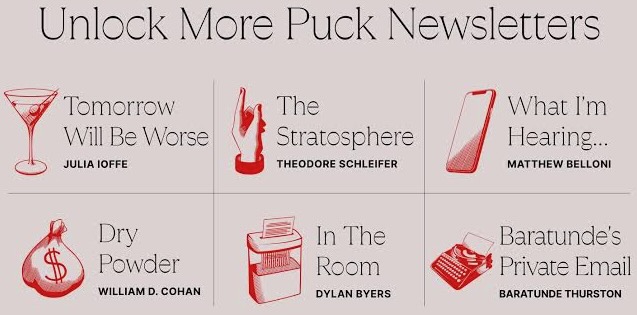
The level of reporting and the cost of a subscription confirm the Puck target audience. But the subs price strategy has not deterred it from selling advertising. Ads do appear on the homepage, but Puck is careful not to interrupt the stories or newsletters with paid messages.
Given the calibre of journalists involved, it comes as no surprise that the stories are well reported, insightful and highly readable. Scoops published across the Puck suite include the revelations that Chris Licht was out as CNN CEO, that Tom Cruise and Paramount are working on Top Gun 3 and details of fast fashion brand She-in’s acquisition of Everlane. This work is frequently cited by other publications that Puck has beaten to the punch.
The scoops underline the Puck model – that journalists are akin to creators and people will follow them for their names and insight. But this talent also needs some institutional support, whether through publishing tech, marketing or ad sales.
By most measures, Puck seems to be working. In August 2023, just two years after launch, it had raised some $10mn in funding. In 2025, it generated revenue of $20mn, boasting 50,000 paying subscribers, according to Axios which noted that the company was not yet profitable but expected to be so in 2026.
Key to this success is the voice, knowledge and contacts of the individual writers. Whether that be Matt Belloni and Kim Masters’s encyclopaedic knowledge of Hollywood, John Ourand’s decade’s reporting on the business of sport, or Julia Alexander’s expertise in streaming. Subscribers want to know what these deeply-connected journalists, and the people they talk to, are saying. They are willing to pay to do so.
Puck has two tiers of subscription. A basic one and the Inner Circle. I’ve noticed an increasing amount of work being put behind that more expensive paywall. Those subscribers also get invites to calls with Puck journalists, reiterating the connection between reader and writer, as well as the “insider” nature of the product. The community approach is also similar to Jessica Lessin’s tech newsletter The Information.
It almost doesn’t need saying that Puck arrived into an already crowded market, and it has only gotten more so. Semafor, launched by Ben Smith and Justin Smith in 2022, is perhaps the clearest example of a competitor, given its focus on key verticals and its use of voicey, recognisable writers such as Max Tani (media) and Ben Smith himself.
But they are quite different businesses.
While both outlets essentially focus on power, Semafor is global, with distinct sections for Africa, Asia and the Gulf. Some of its newsletters are timed for non-US time zones. It also remains paywall free and dependant on top tier advertisers – and the large portfolio of live events that have helped to create a global profile and generate profit within just three years of launch
Given Puck’s structure, there is also an argument that independent, single person newsletters also directly compete with it for readers’ eyeballs and inbox space. I’m thinking Emily Sundberg’s Feed Me, a Substack-based newsletter about how people spend their money and time, particularly in New York, as an example.
The battle between these publications comes down to a few key factors.
Who has the best scoops or latest information, and who offers the writers that readers most want to spend time with?
Five years in, Puck has been keen to maintain its momentum. The founders have brought in new writers and acquired other newsletters. In April 2024, it acquired the Artelligence newsletter, bringing journalist Marion Maneker into the fold. This instantly launched it into a new vertical via a well-respected writer with a mailing list of 32,000 readers (free and paid).
Much more eye-catching was the deal to purchase AirMail, the high-profile newsletter company founded by ex-Vanity Fair editor Graydon Carter. The deal was was said to be worth $16mn in cash and stock. Puck subscribers were given full access to AirMail, immediately making the whole package even more valuable and sticky. It also means that Puck now claims a paying subscriber base of around 100,000.
Like many other outlets, Puck has moved beyond the page and into podcasts. Several of its journalists – Byers, Alexander, Ourand, Belloni – have their own shows. Puck mostly works with Audacy to make these, although Belloni’s “The Town” is actually a partnership with rival company The Ringer. Puck’s flagship show is “The Powers that Be”, a 15/20-minute daily dive into a key story or tow, hosted by co-founder Peter Hamby. These are available to everyone, funded by advertising.
The company is now organizing some big events and gradually going all-in on live contact with readers. Its second “In the Arena” sports media conference is in New York in October: “a day chock-full of exclusive insights about the future of the sports media business”. Those insider calls are a central part of the Puck offering. It also puts on a couple of showy parties during the year. Again, they endorse it as a brand for those ‘in the know’.
With Puck forecasting a debut profit (or at least positive cashflow) this year, it’s worth noting that AirMail claimed to have stopped its loss-making by the time it was acquired. That contributes to the general sense that Puck has established its role and business model for the longterm and may help to inspire others, even those whose star value doesn’t enable them to fundraise a total of $17mn as Puck has done.
The hints and tips for prospective newsletter launchers (who might just band together Puck-style rather than joining Substack individually) surely include the need to build a community of reader-users-contributors through digital, audio, and especially events. Revenue diversity, and encouraging flagship contributors to share the reward (and the risk) also seems an irresistible option.
